

Cement and concrete production currently account for around 8% of global CO2 emissions – more than three times the amount produced by aviation.[i] And unlike fossil fuels, which are gradually being replaced by renewables, it is almost impossible to imagine a world without cement.
The only option is decarbonisation, but this proves to be both challenging and expensive. Opened last year, the Heidelberg Materials plant in Brevik, Norway is currently the only cement plant in operation today with carbon capture. While other projects are underway, scaling this technology requires significant investment which is just not feasible in today’s climate.
Across two days in January, cement experts gathered at the 6th Global FutureCem Conference in Munich to discuss alternative solutions, covering a range of topics from SCM front-runners to waste heat recovery and the role of AI.[ii] According to Christoph Hiesgen, Head of Business Development, E.ON Energy Infrastructure Solutions, the event was extremely content-driven yet “from a practical and not a theoretical sphere”, resulting in intensive discussions and high levels of audience engagement.
The cost of carbon-free cement
“The main theme was that it’s nearly impossible to get rid of carbon with regard to the carbon market situation, because the question is: is the customer willing to pay a premium fee for green cement?” says Hiesgen. “From a technology perspective, nearly everything is possible, but who pays the bill at the end? So, one of the most critical questions was how can we keep the production costs on a reasonable level while making sustainable changes?”
According to Veronica Schwarz, Sales Engineer at Orcan Energy, a leading supplier of energy efficiency solutions, another takeaway from the event was that there is actually a lot of low hanging fruit that can be implemented very quickly, and fairly easily, to reduce CO2 emissions from cement plants.
“Usually at most of these events, the big topic is always carbon capture and storage,” she explains. “Ultimately, to go completely carbon-free, carbon capturing is going to be necessary, but there’s a lot of other steps that can be taken right now.”
Turning waste heat into value
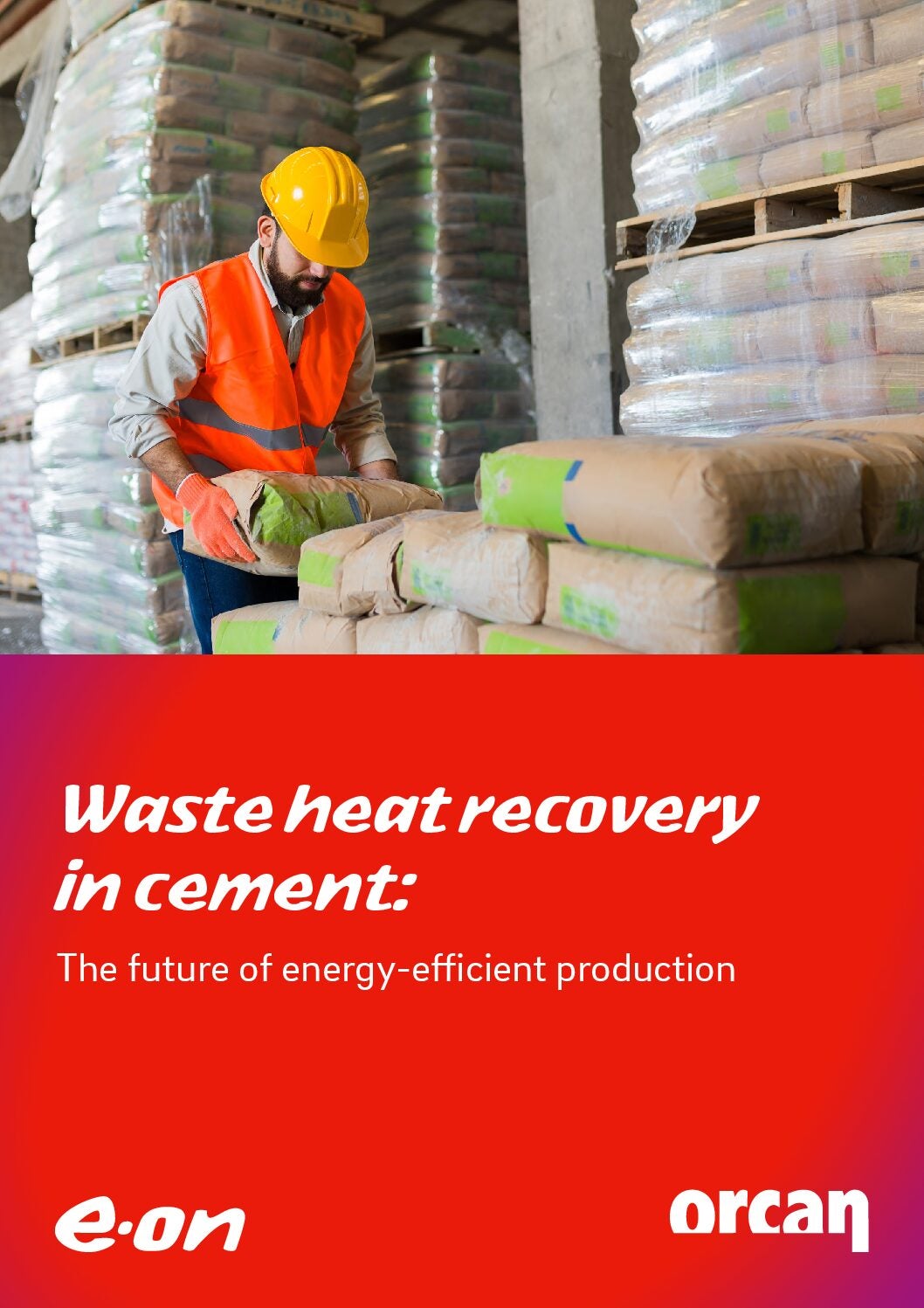
One of the possibilities is turning waste heat into electricity using Organic Rankine Cycle (ORC) technology. According to Schwarz, who was awarded a prize for her presentation at FutureCem, the high volumes of waste heat generated by global cement plants could equate to more than 67 TWh of electricity if converted via ORC. To put that into context, that’s similar to the private household electricity requirements of around 40 million European citizens.
“The main benefit for cement companies is that we save energy costs by producing electricity that can be used right on site,” explains Schwarz. “For the cement plants, it’s baseload electricity – the big advantage for ORC compared to solar power or wind is that we always produce electricity when the plant is in operation, which is the time when they need it most.”
A key focus of Schwarz’s presentation was how ORC technology suppliers like Orcan can make waste heat recovery accessible enough for cement manufacturers to implement today. The answer is flexible, modular systems that can scale up or down, responding quickly to changes in the heat load that occur across the plant’s life. Moreover, through partnerships with companies like E.ON, waste heat solutions can be implemented via a low-risk ‘energy-as-a-service’ model, as shown with E.ON and Orcan’s joint project at Holcim’s Dotternhausen cement plant in Germany.
SCMs are advancing
Elsewhere, much of the conversation focused on advances in supplementary cementitious materials (SCMs), which could reduce the industry’s reliance on clinker – the high-carbon heart of Ordinary Portland Cement.
According to John Kline of Kline Consulting, the US cement industry consumed more than 20Mt of SCMs in 2024, with fly ash harvesting, bottom ash grinding, and natural pozzolan plants all growing nicely. At the same time, recycled glass, biomass ash, recycled concrete fines, and synthetic SCMs are progressing.
Clay calcination projects, which can half the CO2 footprint of cement, have also commenced. Holcim has already invested more than €100 million across several flagship clay calcination projects in Europe and Central America. Amith Kalathingail shared a few of the company’s successes, highlighting its patented ‘baby kiln’ method in use at the Saint-Pierre-la-Cour plant in France, the home of Europe’s first dedicated calcined clay cement production line.
Meanwhile, SCMs are providing economic wins alongside environmental benefits. Joost Oostra told how a clinker grinding project in Colombia quickly pivoted to SCMs to avoid exorbitant clinker import costs. After three years, the plant was consuming 45% clinker and 53% SCMs – most of which were sourced from a nearby landfill site containing 300,000t of broken ceramic tiles.
Digitalisation offers further opportunities
Another theme was the role of digital levers in lowering cement’s carbon footprint. Ali Camgoz of ÇIMSA, Turkey’s leading cement producer, shared how ÇIMSA is using advanced technology to bridge the physical and digital worlds, leading to smarter, more sustainable production ecosystems.
After pooling cement production data from multiple sources, the company built a system to monitor and analyse the information, as well as digital twins of its production lines. The digital twins provide short-term forecasts of fuel and carbon fluctuations, helping to minimise variability, while advanced process control systems contribute to energy savings and reduced carbon emissions.
Meanwhile, Lisa Oberaigner of Emidat explored the impact of the EU’s regulatory shift from Environmental Product Declarations to Digital Product Passports (DPPs). While the new system requires companies to provide digitalised, real-time, on-demand data of a product’s environmental impact, gathering this data offers several advantages for sales and product development.
The key takeaways
Arguably, there is no silver bullet for decarbonising cement. Lower-carbon cement mixes, renewable energy, waste heat recovery, energy efficiency replacements, and digital transformation all play their part in reducing the level of greenhouse gases emitted by this growing industry, while carbon capture will be vital for reaching net-zero in the future.
To learn more, please download the whitepaper below.
[i] “There has to be a financial benefit for doing the right thing” – World Cement Association CEO [ii] https://www.globalcement.com/conferences/global-future-cement/previous/2026-review
