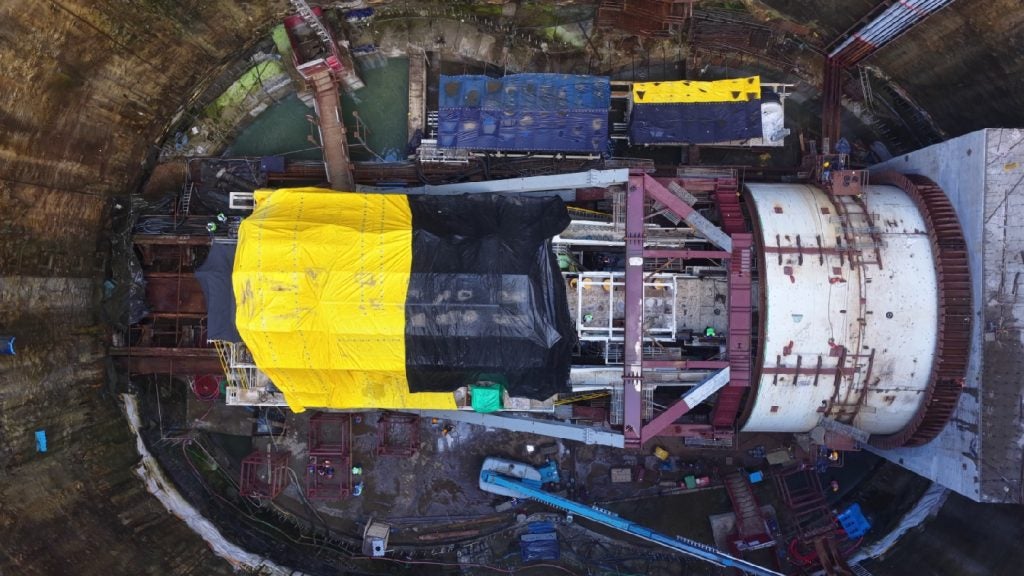
Excavation has commenced for the Mumbai-Ahmedabad high-speed rail project in Mumbai using what is described as India's largest tunnel boring machine (TBM), according to the National High Speed Rail Corporation Limited (NHSRCL).
The TBM will excavate a 6km single-tube tunnel from the Vikhroli shaft towards the under-construction Mumbai Bullet Train station, as part of the wider rail project.
The 21km underground stretch in Mumbai is a key portion of the 508km high-speed rail line that will connect Mumbai and Ahmedabad.
NHSRCL stated that 16km of this underground section, between Sawli (Ghansoli) and Bandra Kurla Complex (BKC), will be excavated using TBMs, while the remaining 5km has already been completed using the New Austrian Tunnelling Method (NATM).
The TBM deployed at Vikhroli features a cutterhead with a diameter of 13.6m and a total length of 96m. The machine weighs about 3,100t.
Designed for complex geological and urban environments, it will operate under multi-storey buildings, roads and rivers, including the Mithi River.
NHSRCL has selected the Mixshield TBM system for this phase, which uses a pressurised bentonite slurry to stabilise the tunnel face and minimise ground settlement.
The system is designed to minimise surface disruption and enhance operational safety in Mumbai’s densely populated areas. A 56m-deep launch shaft has been built at Vikhroli to support tunnelling operations.
NHSRCL has established on-site infrastructure, including water and slurry treatment plants, power substations, bentonite storage and a ready-mix concrete facility for grouting.
Continuous real-time monitoring is in place to ensure safety, using devices such as surface settlement points, optical displacement sensors, strain gauges and seismographs.
A casting yard has also been set up at Mahape in the Thane district to manufacture the estimated 77,000 concrete segments required for the 16km TBM section. Each tunnel lining ring consists of nine curved segments and one key segment.
NHSRCL reports that a waterproof tunnel lining is being installed with double-layer Ethylene Propylene Diene Monomer (EPDM) gaskets and hydrophilic seals.
According to the company, this is designed to provide long-term protection against water ingress and ensure structural durability.
The ongoing Mumbai-Ahmedabad High-Speed Rail project is India’s first bullet train corridor.
The total project cost is estimated at Rs1.08tn ($17bn), with the majority of funding approved through an Official Development Assistance loan from Japan International Cooperation Agency (JICA).
The line is being constructed with Japanese Shinkansen technology and is expected to connect Mumbai and Ahmedabad in about 1 hour and 58 minutes, with an operational target for the first section between Surat and Vapi in August 2027.