
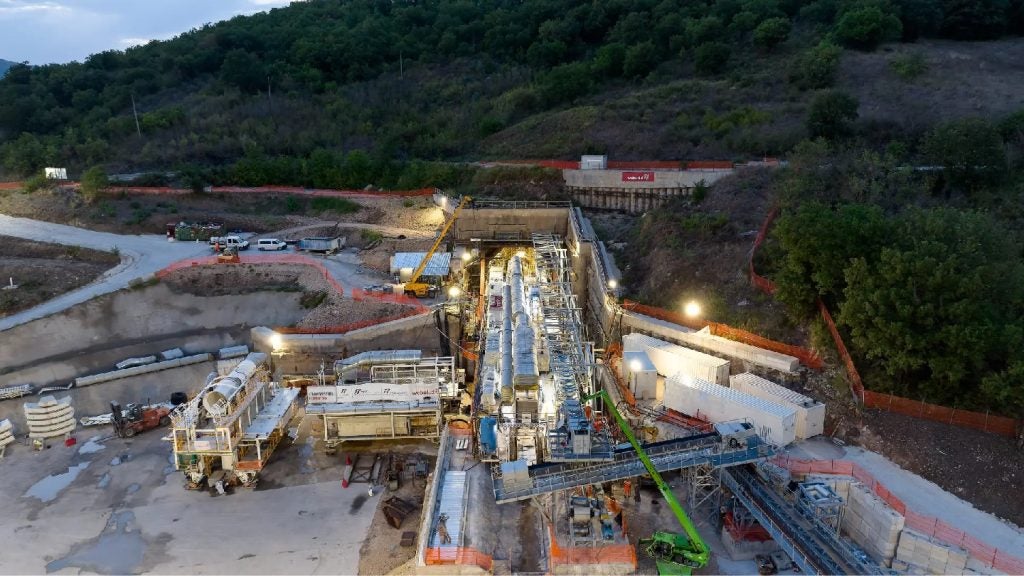
Webuild has started excavating the Melito Tunnel on the Naples-Bari high-speed/high-capacity rail line, deploying a tunnel-boring machine (TBM) named Aurora for the last of three tunnels to be built along the route.
The Melito Tunnel drive is expected to run for about 4.4km under the Southern Apennines.
Webuild is building the section on behalf of Rete Ferroviaria Italiana (RFI), part of the FS Italiane Group.
Aurora, which Webuild said had previously completed the roughly 2km Grottaminarda Tunnel, was dismantled to cross the Ufita River and then reassembled for the new excavation.
The machine has a 12.5m-diameter cutterhead and is about 100m long, with a reported weight of 1,600t.
Webuild stated that the TBM is powered by 18 motors with a combined output of 6.3MW and will operate at a maximum depth of about 130m.
During excavation, it is due to install more than 22,200 precast concrete segments to form the tunnel lining.
The company said more than 140 workers will be involved in operating and maintaining the TBM, working continuously throughout the week.
The Melito Tunnel is the second-longest tunnel on the Apice-Hirpinia Section, which runs through the provinces of Avellino and Benevento for 18.7km. About 13km of this section is in tunnels, or nearly 70% of the route.
It follows completion in May of the 6.5km Rocchetta Tunnel, excavated in 18 months by a second TBM, Futura.
Excavation work on the Melito Tunnel has begun, following the opening of the Naples-Cancello section last July. Also constructed by Webuild, this section links the line to Italy’s national high-speed rail network at the Afragola high-speed station.
The Apice-Hirpinia Section also includes Hirpinia Station, a two-level station with four tracks, alongside access roads, four roundabouts, eight road links and a new parking area.
The Naples-Bari high-speed railway line has a total awarded value exceeding €16bn ($18.2bn).
Across the Naples-Bari line, Webuild is working on four sections: Naples-Cancello, Apice-Hirpinia, Hirpinia-Orsara and Orsara-Bovino. This has created more than 3,000 jobs and involved about 2,800 companies.
The future line forms part of the Scandinavian-Mediterranean Corridor within the Trans-European Transport Network (TEN-T) and is planned to include 145km of new railway.