
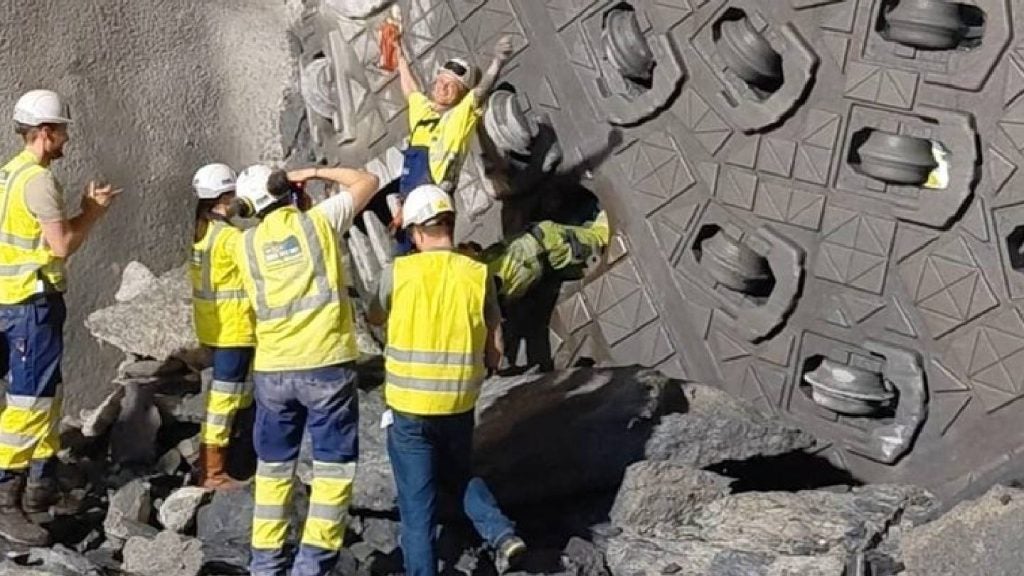
The western main tunnel tube of the Brenner Base Tunnel has been completed following a breakthrough by tunnel boring machine (TBM) Wilma on 25 August 2026.
This achievement links previously separate tunnel sections, creating a single continuous main tunnel extending from Sill Gorge near Innsbruck, Austria, to Fortezza in Alto Adige, Italy.
Wilma's completion marks the first time a main rail tunnel segment has been fully excavated under the Brenner project, part of a 55km railway designed to strengthen freight and passenger connections between Northern and Southern Europe.
The TBM began its journey on 18 September 2024 in the H53 Pfons–Brenner construction lot and advanced approximately 7.5km over a period of 706 days.
According to BBT SE, the project management company, the boring operation required more than 23,000 tubbing rings, with the machine passing through several fault zones that presented challenging and rapidly changing geological conditions.
As a complex assembly with a boring diameter of 10.37m and stretching 180m in length, Wilma operated as a self-contained production facility inside the mountain.
Construction site trains supplied the tunnel segments, conveyor belts removed excavated rock, and technical teams maintained operations while monitoring geological stability.
BBT H53 Pfons–Brenner construction lot project manager Michael Knapp said: “In a project of this scale, logistics are at least as important as the machine itself. We wanted to keep road transport to an absolute minimum. This allowed us to make the processes more efficient while also eliminating around 45,000 lorry journeys.”
Assembly of the TBM required transporting approximately 80,000 individual components in 170 special shipments to a purpose-built underground chamber, underlining the project’s logistical complexity.
The latest breakthrough, achieved at the IRIS auxiliary drivage point between construction lots H53 Pfons–Brenner and H41 Sill Gorge–Pfons, brings the Brenner Base Tunnel a step closer to its role as a central rail artery through the Alps.
Once complete, the Brenner Base Tunnel is expected to offer a flat, high-speed rail route designed to shift significant amounts of freight traffic from road to rail, easing congestion along key European transport corridors between Tyrol and Alto Adige as well as further afield.
The tunnel is also anticipated to decrease travel times between cities such as Innsbruck, Bolzano, and Verona, with potential benefits for cross-border trade and regional tourism through improved transport efficiency. It is also expected to lower CO₂ emissions and noise levels in affected valleys.