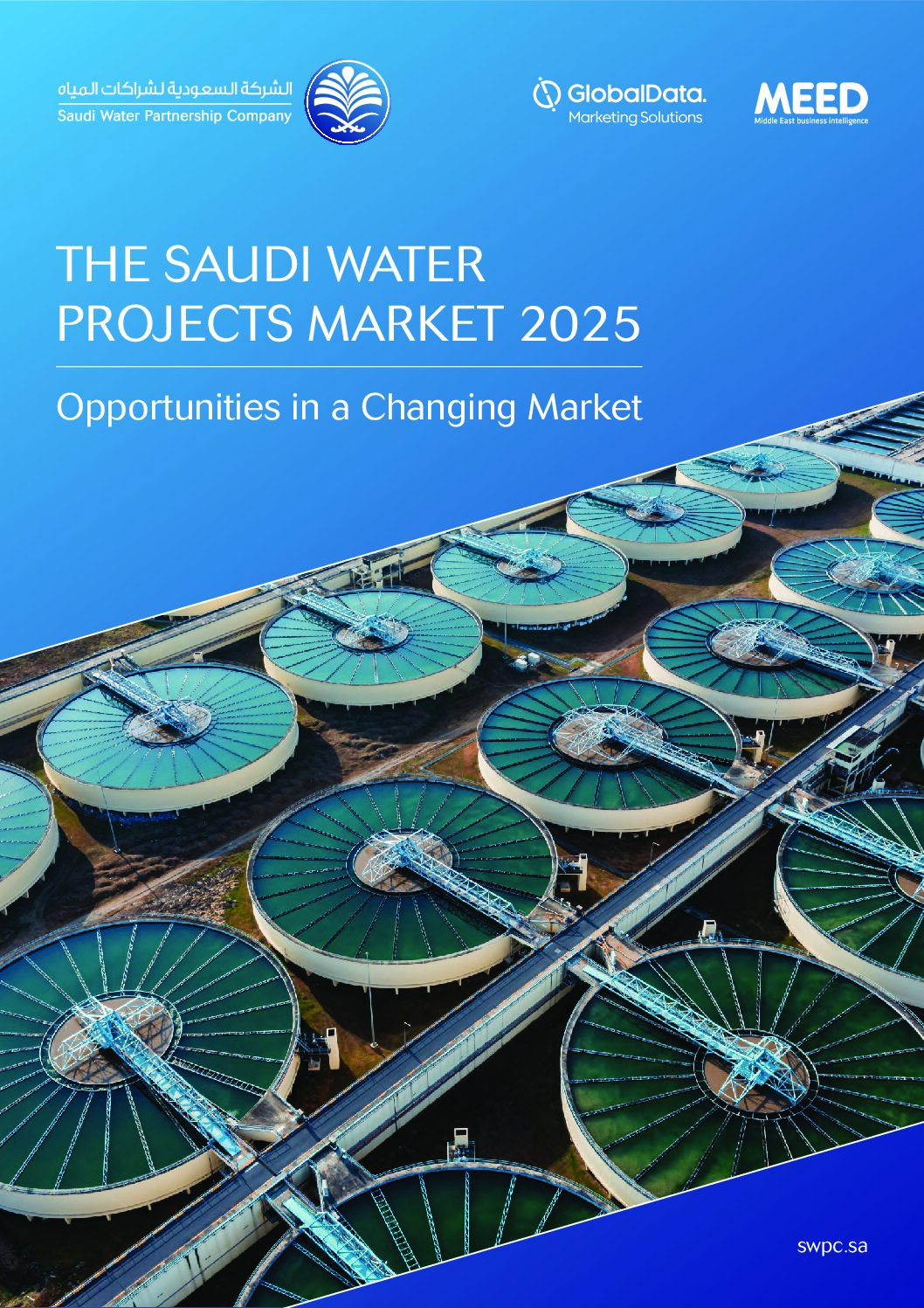


Saudi Arabia is a country with no permanent rivers and limited groundwater. Yet its cities and industries are growing. By 2030, national water demand is expected to approach 18m cubic metres a day. This cannot be managed with small, incremental schemes. Instead, the Kingdom is recruiting an array of private partners to create the world’s largest, most visible pipeline of water projects.
Saudi Arabia’s total contracted production (or desalination) and treatment capacity today is ~11.3M m³/d. This will rise to nearly 16m cubic metres a day by 2028. Eight large desalination plants are due to come online within that period, sitting alongside major expansions in wastewater treatment and reuse. Long-term, desalination will become the backbone of urban water. By 2030, authorities want 90% of all potable water to come from desalination. And treatment plants are just part of the picture; around SAR 60bn of investment in transmission – roughly $16bn – is earmarked for this decade.
Critically, the way these projects are delivered has changed as dramatically as their scale. Historically, water infrastructure was procured through traditional engineering and construction contracts funded on the state balance sheet. Over the past few years, the Kingdom has shifted towards public-private partnerships across almost every part of the water supply chain: independent water projects (IWPs), independent sewage treatment plants (ISTPs), independent water transmission pipelines (IWTPs) and independent strategic water reservoirs (ISWRs).
Between 2018 and 2022, Saudi Water Partnership Company (SWPC) – Saudi Arabia’s principal buyer of desalinated, treated, and untreated water – awarded a series of large seawater reverse-osmosis projects and the country’s first batches of sewage treatment concessions. For investors, that combination of scarcity, clear demand growth and a detailed forward plan points to a market whose unusually strong fundamentals are allowing it to rapidly accelerate. And a range of internationally renowned public-private partnerships are emerging in its wake.
Three projects, one investment story
How are a new generation of private investors in the Saudi Arabian water market making the most of the opportunities offer? Projects at Juranah, Rayis–Rabigh and Rabigh 4 reflect on-the-ground realities – and why partners are willing to commit capital and expertise for decades at a time.
Juranah, near Makkah, is Saudi Arabia’s first privately financed strategic water reservoir. It will provide 2.5m cubic metres of total storage – combining strategic reserves with operational tanks – under a 30-year build–own–operate–transfer concession serving the Holy City’s residents and pilgrims. The project came online in December 2023 and achieved financial close in May 2024, with commercial operation planned for May 2027; it is being delivered by a consortium led by Vision Invest and TAQA (35% each) alongside Gulf Investment Corporation (30%), with MAPA as EPC contractor. Its design incorporates solar PV and a rising local-content commitment over the life of the contract – signalling a partnership that is here to stay.
Further up the Red Sea coast, the Rayis-Rabigh independent water transmission pipeline is among the early IWTP schemes tendered by SWPC. It explicitly buys capacity, reliability and system resilience. The project will comprise a 152km pipeline rated at 500,000 cubic metres a day upon its targeted opening later in 2026, with 340,000 cubic metres of potable-water storage integrated into the system. It will support supply to both Makkah and Madinah, allowing flows in either direction as conditions require. Backed by a 35-year BOOT contract and a reported cost of about SAR 2.4bn, it is being developed by Alkhorayef Water and Power Technologies and Cobra on a 50:50 basis. Its pitch to investors is straightforward: long-dated contracted revenues for a defined asset, reinforced by energy-efficiency measures and a gradual increase in local-content requirements after commissioning.
Rabigh 4, an independent water project on the same coast, completes the picture. With planned output of 600,000 cubic metres a day, it pairs production with 1.2m cubic metres of potable-water storage – the first project in its class locally to bundle both elements – under a 25-year build–own–operate contract scheduled to reach commercial operation this year. The scheme, valued at more than SAR 2.5bn, is being developed by a consortium led by ACWA Power (45%), alongside Haji Abdullah Alireza & Co (35%) and Al Moayyed Contracting Group (20%), through the Rawabi Water Desalination Company. It also includes integration and expansion works for a 380/110kV substation, and has already recorded nine million safe man-hours without injury. With renewables incorporated and local-content targets that rise through operations, Rabigh 4 reinforces the Kingdom’s preference for assets that are large, financeable and built to run.
SWPC – your go-to infrastructure partner
At the centre of Saudi Arabia’s pro-partnership economy sits SWPC. It acts as the single buyer of produced water from both public and private plants and as the government’s PPP procurement arm for the sector. Instead of dozens of local utilities running separate competitions, there is one entity with a standardised process and a clear mandate. This centralisation makes navigating the vibrant Saudi Arabian water market a breeze.
SWPC provides a common contractual framework that runs across desalination, wastewater, transmission and storage. Concession agreements typically run for 20 to 30 years. The private sector finances, builds and operates the asset. SWPC commits to take the water and to pay an agreed tariff over the life of the contract. This structure shifts construction and operation towards the private side while anchoring revenue on a long-term, sovereign-backed commitment.
Scale matters too. SWPC’s seven-year statements, combined with the broader national plans, lay out a dense pipeline of schemes: new desalination plants, ISTPs, IWTPs and ISWRs. This allows investors and lenders to build Saudi Arabia into their long term plans as a core market, creating dedicated teams and local offices accordingly. Once they have mastered the tender process and financing structure for one project, the next opportunity looks recognisably similar. That repeatability lowers transaction costs and encourages bidders to stay engaged through multiple procurement rounds.
The financing community has responded in kind. Large international banks, regional lenders and export credit agencies have all backed Saudi water deals, enticed by long-dated, predictable cashflows. For projects such as Juranah, Rayis-Rabigh and Rabigh 4, this has meant an unbeatable pool of potential financiers once contracts are awarded.
And it is a pool with enough depth for many more investors to dip into yet. As water demand rises and the network of plants, pipelines and reservoirs thickens, new projects will continue to arrive. The same structures that brought in the existing partnerships point to how Saudi Arabia’s water market will remain a focal point for international infrastructure partnerships for many years to come. Curious to learn more about SWPC could bring your investment ambitions to fruition? Download the whitepaper on this page.