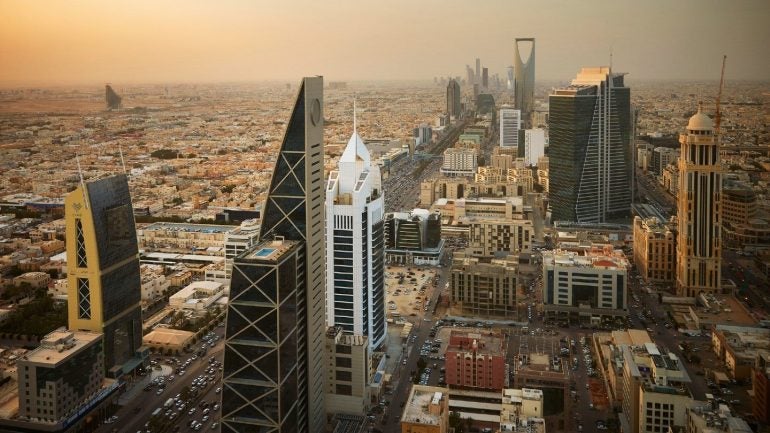
Across the GCC, governments are racing to pivot away from traditional sources of wealth towards bricks, mortar and digital infrastructure. Nowhere is this clearer than in Saudi Arabia. Under its Vision 2030, the Kingdom is using its status as the largest economy in the GCC to reposition itself as a magnet for global capital.
Culture, tourism, retail, hospitality and housing are central pillars of this shift. Vision 2030 initiatives saw non-oil GDP rise to nearly $700bn by 2024 from a base of just over $530bn; it is projected this will almost double by 2030. Overall GDP will rise from $956bn to $1.73tn over the same period.[1]
The scale of the investment push underpinning these statistics is hard to ignore. With about $419.3bn of projects planned or underway, and a further $1.57tn in the pipeline, Saudi Arabia is by far the largest projects market in the MENA region regarding projects under execution or forthcoming.[2] Construction dominates that pipeline, followed by power, water and transport. A decisive political and commercial shift towards building new cities, reshaping existing ones and upgrading the infrastructure that links them is driving major activity. For investors and businesses seeking commercial space in the Kingdom, this comes with major opportunity: this is an economy where a long, visible queue of real assets are coming to the market.
The sectors driving activity
A fast-growing population, urbanisation and rising household incomes are fuelling demand for new homes, communities and social infrastructure in Saudi Arabia. This has been a boon for the construction sector. Spanning everything from apartments and villas to mixed-use districts, hotels, cultural venues and data centres, residential and mixed-use schemes are taking the largest share of planned spending. Mega-developments, including those from Diriyah Company, underline how central housing and city-building have become to the Kingdom’s diversification.
There are almost $111.9bn worth of projects currently in the execution or development stage in the Kingdom’s construction sector.[3] Housing makes up a big chunk of this; the largest current subsector in terms of work under execution is in apartments, with $19.1bn worth of work underway, followed by the houses and villas with $15.2bn, then hotels and resorts with $12.8bn.[4] Behind the numbers sits a supportive policy backdrop. Vision 2030 explicitly seeks to expand the non-oil economy, and that ambition has been backed by reforms: more generous rules on foreign ownership in many sectors, streamlined licensing and residency options designed to keep international talent in the country.
Key growth hubs come to the fore
Riyadh is the main stage. The capital is growing rapidly, drawing in multinational companies through a Regional Headquarters programme that offers tax incentives and access to a large, reforming market. This is driving demand for offices, housing and lifestyle destinations. It points to a city whose fundamentals – population growth, corporate inflows and public-sector backing – are pulling in the same direction, making it the ideal place to set up a commercial enterprise.
As economic vibrancy spreads out from the centres of today, it is creating the hubs of tomorrow. Diriyah, for example, is both the birthplace of the First Saudi State and a UNESCO World Heritage site that is now the cornerstone of the Diriyah project, which is being developed as a major culture and lifestyle destination. Backed by the Public Investment Fund, the project combines a historic core with new districts of homes, hotels, cultural and entertainment venues and workplaces across a 14-square-kilometer masterplan. By 2030, the development aims to host tens of millions of visits a year, provide housing for around 100,000 residents and directly create 180,000 jobs, tying national history to a modern urban economy.
The case for Diriyah as a bustling commercial hub for regional corporate offices is broad. It plays host to a wide range of different leasing options, from as little as 65 square metre office spaces all the way up to whole building and campus-style solutions. For those starting from scratch, Diriyah Company offers everything from public-private partnerships and joint ventures to co-development and direct real estate deals across residential, hospitality, retail, cultural and smart-city assets. And connectivity strengthens the case. Diriyah will be linked to central Riyadh by four metro stations, placing the historic core a short ride from the city’s main business districts and within easy reach of King Khalid International Airport.
How international capital can capitalise
For international investors and firms seeking new office space in the region – whatever their size – attending MIPIM Asia this December, all of this makes Diriyah Company an instructive case study in how rising GCC cities are blending world class amenities with long-term yields. Sitting within a national projects market that remains the largest in the region, it highlights there are still major opportunities to be taken.
Diriyah Company delegates, who will be present at MIPIM Asia 2025, offer a direct line to the team shaping this new city, along with a clear view of the residential, hospitality and mixed-use assets in the pipeline. It is the place to establish Diriyah’s role in your long-run GCC expansion plan, with a body of experts poised to assist every step of the way.
[1] https://www.vision2030.gov.sa/en/explore/key-performance-indicator
[2] Meed report, “Saudi Arabia Projects H2 2025”, 2025.
[3] Ibid.
[4] Ibid.
