

Hong Kong’s Financial Secretary Paul Chan Mo-po unveiled the Fiscal Year (FY) 2026-2027 (April 2026 to March 2027) Budget on 25 February 2026. The budget focuses on innovation and artificial intelligence, while aligning the city’s economic future with national development. Framed against a backdrop of global trade uncertainty, the 2026 Budget outlines measures to support businesses and individuals, accelerate infrastructure and technology development, and reinforce the city’s role as an international trade and financial hub. 2026 marks the first year of China’s 15th Five-Year Plan (2026 to 2030), with Hong Kong’s Budget outlining efforts to align with this national economic blueprint. The Financial Secretary Chan has also announced that Hong Kong will formulate its inaugural five-year plan, indicating that the region’s development trajectory will align closely with the national policy priorities in the coming years. As per the estimates announced in the Budget, Hong Kong’s economy is expected to expand in the range of 2.5%-3.5% in 2026, compared to 3.5% in 2025. Inflation in 2026 is expected to be moderately higher than that in 2025, with the underlying inflation rate and the headline inflation rate projected at 1.7% and 1.8%, respectively, in 2026; the underlying inflation rate was 1.1% in 2025. The economy is then projected to expand at an average annual rate of 3% in real terms from 2027 to 2030, with an average underlying inflation rate of 2%.
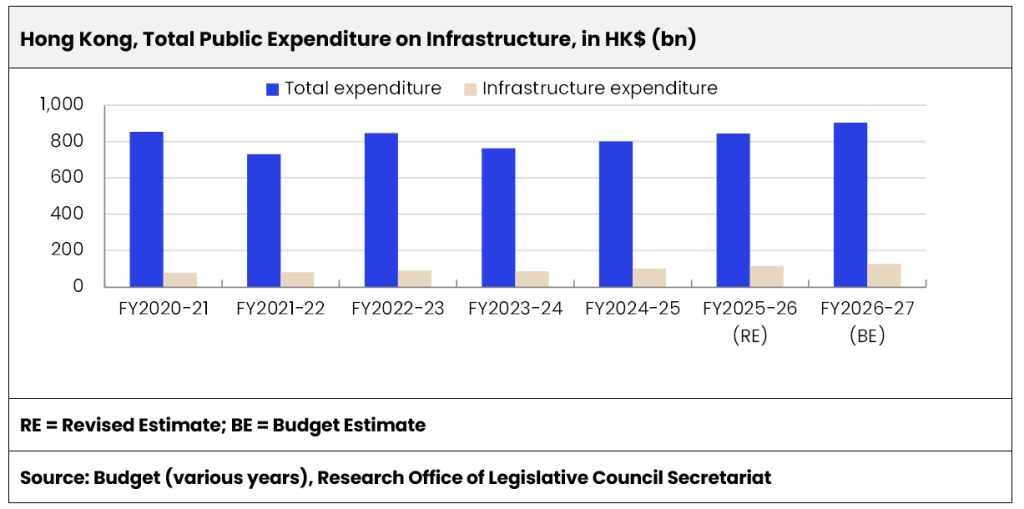
Total government expenditure for FY26‑27 will increase by 6.9%, from HK$789.2bn ($101.2bn) in the revised estimate (RE) of FY25-26 to HK$843.4bn ($108.2bn). 75.9% of the total government expenditure earmarked for FY26-27 – equivalent to HK$640.2bn ($82.1bn) – is for operating expenditure, while the remaining 24.1% – equivalent to HK$203.2bn ($26.1bn) – is for capital expenditure; this marks an increase of 6.4% and 8.6%, respectively, compared to the expenditure in the RE FY25-26 Budget. Considering the expenditure by other public bodies, the total public expenditure totals HK$904.7bn ($116bn) in FY26-27. Of the total public expenditure earmarked for FY26-27, 16.9% is for the healthcare sector, while 16.4% is for social welfare; 13.8% for infrastructure; 12.4% for education; 7.9% for security; and 7.1% for housing, among others.

Access deeper industry intelligence
Experience unmatched clarity with a single platform that combines unique data, AI, and human expertise.
Infrastructure development
Some of the initiatives announced in the latest budget that are expected to drive growth in the transport infrastructure sector are:
- In early February 2026, the Government announced the Transport Strategy Blueprint, outlining strategies and recommendations for the sustainable development of the transport system in Hong Kong. The blueprint aims to enhance cross-boundary transport infrastructure, facilitate the movement of people and goods within the Guangdong-Hong Kong-Macao Greater Bay Area (GBA) region, and drive smart transformation to provide convenience for the public.
- The government also announced that it is moving ahead with a series of railway, major road, and Smart and Green Mass Transit System projects to form an “Eight Vertical and Eight Horizontal” layout. Of them, the Central Kowloon Bypass (Yau Ma Tei Section) is open to traffic, as of February 2026, while the Kowloon Bay Section is expected to be completed by the end of 2026. Some of the railway projects under construction include Kwu Tung Station, Tung Chung Line Extension, Hung Shui Kiu Station, Tuen Mun South Extension and Oyster Bay Station.
- The government is also moving forward with the Northern Link Main Line and Spur Line, for commissioning simultaneously by 2034 or earlier. It is also actively progressing with the Hong Kong-Shenzhen Western Rail Link (Hung Shui Kiu-Qianhai) project, with the target of inviting tender for its detailed design and construction in 2027 and commissioning in 2035.
Land and housing
- The government plans to make available land to produce approximately 98,000 private housing units in the next five years. Together with railway property development projects, the Urban Renewal Authority (URA) initiatives, and private development and redevelopment projects, the total potential land supply for the year is expected to support the construction of approximately 22,000 units.
- The government also announced that, due to the high vacancy rate in the non-residential property sector and the prevailing supply and demand conditions, it will not put up general commercial sites for sale in the coming year.
- Subject to market response, the government plans to make three post-secondary student hostel sites available for land sale.
- The total public housing production, including light public housing projects, over the next five years is expected to reach around 196,000 units. This marks an increase of over 80% compared with the five-year period since the current-term government took office.
- According to the government estimates for private housing, completions will average approximately 17,000 units annually over a five-year period, starting from this year; this is approximately 8% lower than the annual average of the past five years.
- The potential supply of first-hand private residential units over the next three to four years is estimated at approximately 104,000 units.
Diversified development
- The Government plans to allocate HK$1.7bn ($212.9m) for the Hong Kong Tourism Board in FY2026-27 to enhance Hong Kong’s tourist appeal.
- Allocate HK$1.2bn ($153.9m) towards the sports portion of Arts and Sport Development Fund to support sports development.
- Allocate HK$1bn ($128.3m) for the Built Heritage Conservation Fund to enrich city culture
- Allocate HK$200m ($25.7m) to launch the pilot Northern Metropolis (NM) Urban-rural Integration Fund to support rural tourism projects
- Earmark resources to launch the five-year waste reduction and recycling plan from FY2026-27.
- Explore the establishment of a Hong Kong-based Green Technology Projects Accelerator with Mainland and multilateral financial institutions
- Provide a HK$10bn ($1.3bn) loan to support campus development in the NM University Town.
- Reserve land and resources for developing a new medical school and an integrated medical teaching and research hospital in Ngau Tam Mei
- Allocate HK$65m ($8.3m) to provide additional government-funded training places for construction professionals.
Elderly care and enhancing healthcare services
- From the upcoming financial year, the government will increase the number of Community Care Service Vouchers for the elderly by 4,000 – to 16 000, and the number of Residential Care Service Vouchers for the elderly by 1,000 – to 7,000; this is estimated to involve a full-year expenditure of HK$1.2bn ($153.9m) and HK$1.97bn ($252.7m) respectively.
- The Government plans to deepen the development of primary healthcare in the community by launching the Primary Healthcare Co‑care Network; this will extend screening to include hepatitis B and other diseases, strengthen cross‑disciplinary collaboration, and improve support services. The target participation for the first five years is approximately 700,000 persons.
- The Government reported that the 16 projects under the First Hospital Development Plan will be completed progressively. It also said that it will consider the latest demographic structure and distribution and review the scale and priority of projects under the Second Hospital Development Plan.
- The Government will enhance rehabilitation services by providing approximately 450 additional places for day, residential and pre‑school services in the upcoming financial year; this involves an additional annual expenditure of approximately HK$107m ($13.7m).
In another boost to the Hong Kong construction industry’s output, as part of the latest budget, the Government announced that it will inject HK$1bn ($128.3m) into the Construction Innovation and Technology Fund to support the professional development of Hong Kong’s construction industry. The fund will help in promoting the industry‑wide application of innovation and technology (I&T), thereby enhancing productivity and site safety, along with reducing construction costs.
Additionally, the Development Bureau (DEVB) is implementing various measures to reduce construction costs and enhance effectiveness by enhancing the project procurement model and streamlining the approval process. The government has also announced a plan to allocate HK$100m ($12.8m) for the Building Technology Research Institute to support studies reviewing construction standards and exploring artificial intelligence (AI) applications.
US Tariffs are shifting - will you react or anticipate?
Don’t let policy changes catch you off guard. Stay proactive with real-time data and expert analysis.
By GlobalData