
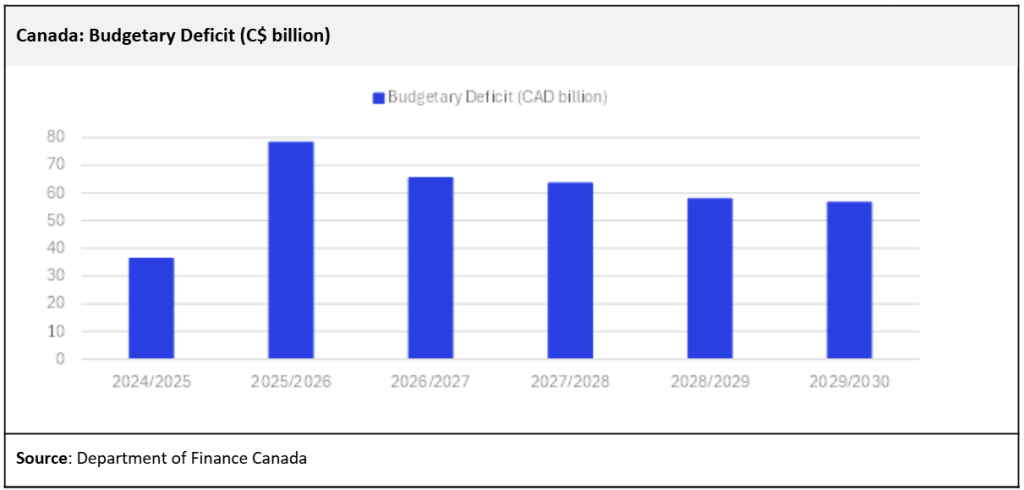
In November 2025, Canada’s 2025-2026 federal budget was delivered by the Minister of Finance and National Revenue François-Philippe Champagne, under Prime Minister Mark Carney. The 2025-2026 federal budget titled ‘’Canada Strong’’, lays out C$280bn ($205.1bn) in spending over the next five years. The new budget also showed a deficit of C$78.3bn ($57.4bn) for 2025-2026, which is projected to decrease to C$65bn ($47.6bn) in 2026-27, C$64bn ($46.9bn) in 2027-2028, C$58bn ($42.5bn) in 2028-29, and C$56.6bn ($41.5bn) in 2029-2030. Canada’s 2025-26 budget deficit increased significantly owing to heightened spending on defence, infrastructure, and housing sectors, alongside weaker economic growth forecasts, particularly impacted by the US trade tariffs and the ongoing global uncertainties.
The federal government of Canada also announced its plan to attract approximately C$1tn ($732.6bn) in investment over five years, while also imposing C$60bn ($44bn) in cuts, including trimming 40,000 public-sector jobs—about 10% of the workforce and up to 15% reductions across ministries to save C$44bn ($32.2bn). Of the total budget, 42% is aimed at strengthening Canadian sovereignty, 36% to bring down costs for Canadians, and the remaining 22% for the additional actions to support Canadians. The plan seeks to double non-US exports in a decade, lower the business marginal effective tax rate (METR) from 15.6% to 13.2%, and invest C$1.3bn ($1bn) to draw global researchers over the next 12 years. The government is also planning to increase the defence spending from 2% of GDP in 2026 to 5% by 2035, including C$81.8bn ($59.9bn) over the next five years.

Access deeper industry intelligence
Experience unmatched clarity with a single platform that combines unique data, AI, and human expertise.
Prime Minister Mark Carney also reverses several Trudeau-era policies by slashing temporary-resident targets from 673,650 to 385,000 next year and to 370,000 in 2027–2028, offering 33,000 work-permit holders’ permanent residency. Furthermore, to counter Trump-era tariffs—including a blanket 35% duty in September 2025, the government of Canada announced C$5bn ($3.7bn) in spending to help tariff-affected industries, coupled with C$1bn ($732.6m) for steel-sector transition and a C$10bn ($7.3bn) loan facility.
Canada is currently experiencing several significant changes due to an unprecedented increase in tariffs, which has resulted in a higher cost of living, mounting financial pressure on families and small enterprises, escalating unemployment rates, and reduced productivity. However, Canada, through its 2026 federal budget, is aiming to make generational investments while maintaining Canada’s strong fiscal advantage, which allows it to invest ambitiously and responsibly, and build Canada’s economy to be the strongest in the G7. As a response to tariffs imposed by the US Government, in late March 2025, Carney announced the formation of the Trade Diversification Corridor Fund (TDCF) to diversify Canada’s trade away from its heavy reliance on the US.
Under the TDCF, the federal government plans to provide C$5bn ($3.7bn) over seven years, in ports, freight railways, inland terminals, airports, and highways, to build and strengthen the movement of goods and labour to consolidate the Canadian economy. Moreover, Canada has the lowest net debt-to-GDP ratio and is one of the smallest deficit-to-GDP ratios in the G7. The government is also working on a new approach to reduce its operational expenditures and plans to allocate more resources towards the nation’s infrastructure and economic growth.
Some of the major allocations under the 2025-2026 federal budget includes C$110bn ($80.6bn) for productivity and competitiveness over five years, C$54bn ($39.6bn) for core public infrastructure such as water, wastewater, and transit, C$37bn ($27.1bn) for health and innovation, C$30bn ($22bn) for defence and security, C$25bn ($18.3bn) for housing, C$19bn ($13.9bn) for Indigenous and municipal infrastructure, along with another C$5bn ($3.7bn) for trade and transport.
US Tariffs are shifting - will you react or anticipate?
Don’t let policy changes catch you off guard. Stay proactive with real-time data and expert analysis.
By GlobalData
Reports
Canada Construction Market Size, Trend Analysis by Sector, Competitive Landscape and Forecast to 2029 (Q3 2025)
Canada’s 2025-2026 federal budget places significant emphasis on the construction industry by allocating substantial funds for the development of the country’s infrastructure, with a commitment of approximately C$115bn ($84.2bn) over five years for essential public works such as water, transit, health, and innovation. Additionally, there is an allocation of C$25bn ($18.3bn) to be directed towards housing initiatives, including the Build Canada Homes program and the Build Communities Strong Fund. Along with the allocation of funds, the government announced its commitment to create policy measures to provide low-cost financing for builders, incentives for purpose-built rental construction, streamlined regulations, pro-competitive reforms, and a reduction of taxes on construction investment.
In late August 2025, Carney launched the new Major Projects Office (MPO) to fast-track nation-building projects, along with streamlining the financing and federal regulatory approval process for “national interest projects”. Under the 2026 federal budget, the MPO will receive C$264m ($193.4m) over five years to accelerate nation-building projects. To evaluate if a project qualifies as being of “national interest”, the MPO applies the following criteria:
- Whether a project will strengthen Canada’s autonomy, resilience and security
- Whether a project will provide economic or any other benefits to the country
- The probability of successfully executing a project
- The advancement of a project in relation to the interests of Indigenous Peoples is a matter of consideration
- Whether a project will contribute to clean growth and address climate change
Furthermore, the 2025-2026 federal budget has allocated C$17.2bn ($12.6bn) to support provincial and territorial housing, health, and education infrastructure projects over the next ten years, starting from 2026-2027. Of the total amount, C$5bn ($3.7bn) is allocated for the construction of hospitals, emergency rooms, urgent care facilities, and medical schools over the upcoming three years, through the Health Infrastructure Fund. Moreover, the Build Communities Strong Fund (BCSF), a ten-year-long initiative of the Department of Housing, Infrastructure and Communities, will also help drive the investments in the construction industry. Starting from 2026-2027, the BCSF encompasses investments amounting to C$51bn ($37.4bn), which will support municipalities, indigenous communities, and non-profit organisations in constructing stronger and more resilient communities throughout Canada by facilitating the development of a diverse range of infrastructure projects.
Additionally, the federal government will invest approximately C$13m ($9.5m), starting in 2026-27, to upgrade Canadian airports through the Airports Capital Assistance Program. The government, under the 2026 federal budget, also earmarked nearly C$186m ($136.6m) in new funding to fully implement the Buy Canadian Policy, including C$98.2m ($71.2m) for the implementation of the Public Services and Procurement Canada (PSPC) and C$79.9m ($58.5m) over five years will go toward launching the Small and Medium Business Procurement Program to help Canadian small- and medium-sized enterprises (SMEs) access federal contracts.
Furthermore, the Buy Canadian Policy will also be applied to infrastructure expenditures and various federal funding sources, ensuring that up to C$70bn ($51.3bn) in extra public investment will bolster Canadian-manufactured goods and services. Moreover, in November 2025, the Canada Mortgage and Housing Corporation estimated that to restore affordability to 2019 levels, homebuilding activity in the country should double from its current pace of around 280,000 homes per year to between 430,000 and 480,000 homes per year over the next decade.
Meanwhile, the Parliamentary Budget Officer (PBO) estimates that constructing 290,000 homes per year would be sufficient to address the housing shortage. Considering the federal government allocations to infrastructure and housing sectors, coupled with rising investments to modernise its electrical grids to meet the growing demand for clean energy, Canada’s construction industry is expected to stay competitive and resilient in a shifting global economy.
