
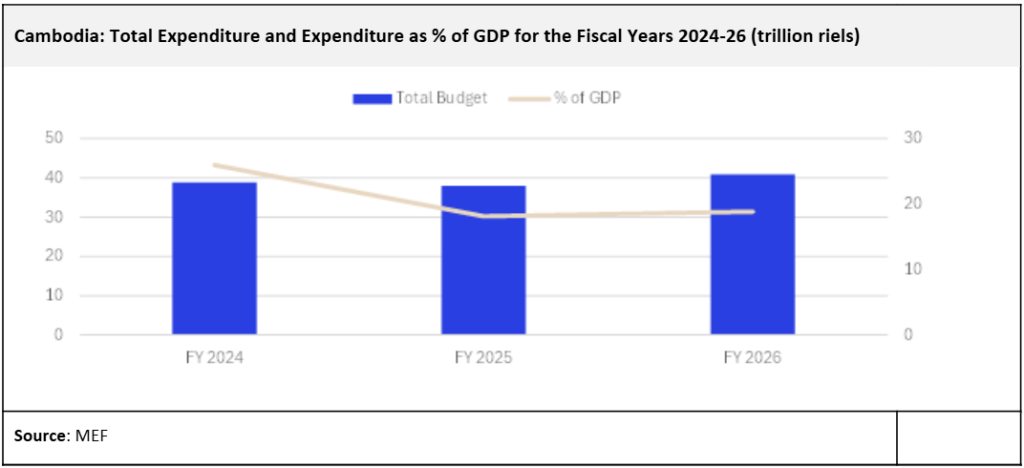
In October 2025, the Cambodian Government approved a draft 2026 national budget, with a total expenditure of 40.9 trillion reils ($9.9bn), representing an increase of 7.8% compared to the 2025 State Budget. The new budget prioritizes defense, national security, education, healthcare, digitalisation, and infrastructure sectors, aiming to sustain GDP growth of 5.2% in 2025 and 5% in 2026. The 2026 budget is prepared in line with the Medium-Term Public Financial Framework for 2026–2028, based on a comprehensive assessment of three major factors: a declining trend in revenue, increasing pressure from expenditure needs, and a decline in government savings due to the impacts of the Covid-19 crisis from which recovery has not yet been achieved. The budget emphasises institutional modernisation, governance reform, and regional competitiveness, linking economic development with national security and stability. The new draft Budget for 2026 will also account for 18.9% of the country’s GDP, compared to 18.1% in 2025.
However, the draft budget bill for 2026 has yet to be approved by the National Assembly and subsequently examined by the Senate prior to its submission to King Norodom Sihamoni for his endorsement. In December 2025, Cambodia’s Royal Government formally authorised the government to collect approximately 30.3 trillion reils ($7.3bn) in revenue for the 2026 fiscal year. The Ministry of Economy and Finance (MEF) will oversee this target, which aims to boost national income through tax collection and fiscal discipline. Of the total, fiscal revenue is expected to amount to 25.3 trillion reils ($6.1bn) while non-fiscal revenue is estimated at 3.9 trillion reils ($936.4m), with the remaining 1.1 trillion reils ($262m) to be collected through other revenue sources.

Access deeper industry intelligence
Experience unmatched clarity with a single platform that combines unique data, AI, and human expertise.
Cambodia is planning to borrow approximately 12.8 trillion reils ($3.1bn) Special Drawing Rights (SDR) in concessional loans from international financial institutions and development partners, to support public investment infrastructure projects in 2026, while keeping the national debt at a manageable level, increasing its borrowing ceiling from 10.7 trillion reils ($2.6bn) in 2025. However, the Cambodian government did not disclose the detailed allocations by sector; it is reported that the Ministry of National Defense will be allocated a budget of 3.1 trillion reils ($750m), accounting for approximately 7.8% of the government’s total planned expenditure in 2026 and an increase of 1.2% compared to 2025.
Furthermore, to build a resilient, digital and inclusive financial system, the National Bank of Cambodia launched its Financial Sector Development Strategy 2025–30 (FSDS) in December 2025. The strategy targets a 5% economic growth in both 2026 and 2027, despite the headwinds such as the US tariffs and ongoing border tensions with Thailand. FSDS 2025-30 is the fourth update of this strategic document since its initial launch in 2001. Moreover, the Cambodian government approved a 2.1 trillion reils ($512.9m) issuance of government bonds in early January 2025, which will finance the investment projects and maintain the balance of the national budget for 2026. The issued bonds will also support the development of Cambodia’s domestic capital market, according to the Ministry of Economy and Finance (MEF). Earlier in November 2025, the Asian Development Bank (ADB) approved 206.1 billion reils ($50m) policy-based loan to boost Cambodia’s financial stability and digital infrastructure, along with supporting banking and non-banking institutions.
Growing public spending on transport and renewable investment projects, along with a surge in the authorisation of new construction projects, is expected to lead to high construction activity in Cambodia. According to GlobalData, the Cambodian construction industry is expected to record an annual growth of 6.6% in 2026, before growing at an annual average growth of 8.2% between 2027 and 2030. According to the Council for the Development of Cambodia (CDC), 630 new investment projects worth approximately 41.1 trillion reils ($10bn) were registered in 2025, registering a 52% increase in project numbers and a 45% rise in investment capital compared to 2024. Major projects include the Funan Techo Canal project, hydropower, solar and wind energy power plants, healthcare facilities, dry ports, and manufacturing plants. Moreover, in October 2025, the government announced a plan to invest 13.6 trillion reils ($3.3bn) in 23 river transport and logistics projects, under the Comprehensive Intermodal Transport and Logistics System (CITLS) 2023–33 master plan, which aims to boost connectivity, trade efficiency, and competitiveness. There are 16 short- and medium-term projects (2023-27) under the initiative, which are worth 10.7 trillion reils ($2.6bn) and nine long-term projects (2028–33) valued at 2.8 trillion reils ($690m). Additionally, Cambodia’s target of raising its renewable energy production in the total energy mix from 59.2% in March 2024 to 70% by 2030, coupled with the country’s Power Development Masterplan 2022-40 (PDP) and the National Energy Efficiency Plan (NEEP) 2022-30, which will also bolster private investments in the renewable energy projects.
US Tariffs are shifting - will you react or anticipate?
Don’t let policy changes catch you off guard. Stay proactive with real-time data and expert analysis.
By GlobalData