

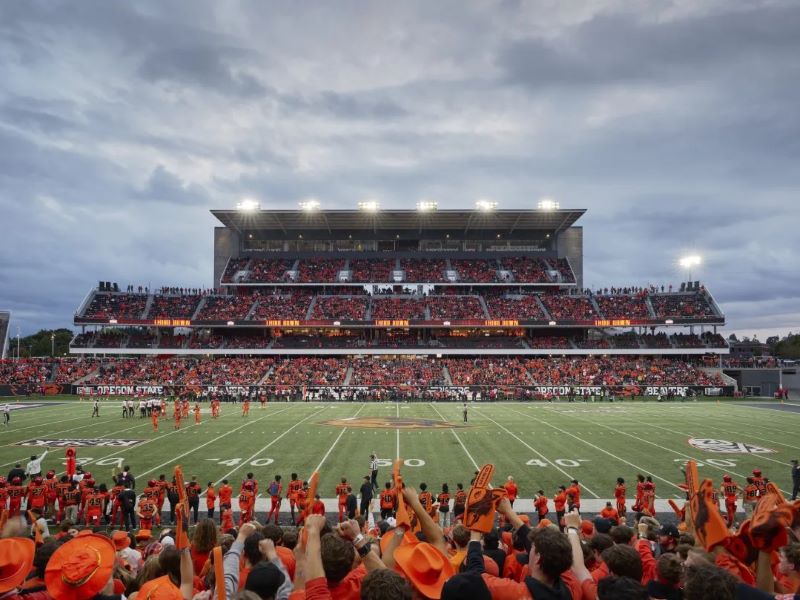
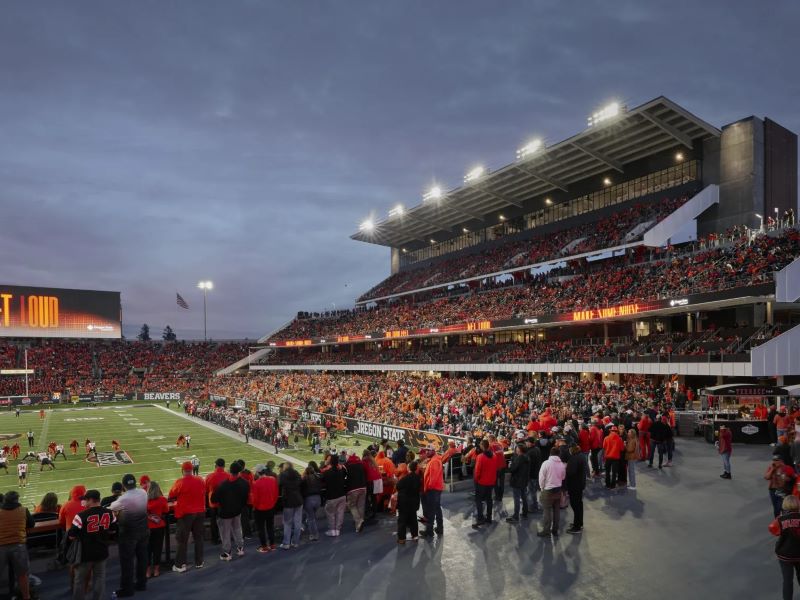
The Reser Stadium in Oregon, US, underwent a $153m renovation and redevelopment project, transforming it into a world-class football facility.
Located within the campus of Oregon State University (OSU), the sports stadium is the home venue of the Oregon State Beavers football team.
Recommended Buyers Guides

The renovation project involved the complete demolition and reconstruction of the Reser Stadium’s west side and the development of year-round university facilities to meet the needs of OSU students and faculty.
The project was approved by the OSU Board of Trustees Finance and Administration Committee in January 2021, while final approval was considered by the board of trustees in May 2021.
Construction commenced after the completion of the university’s 2021 football season.
The project was completed before the start of OSU’s 2023 football season in August 2023.
The redevelopment complements the additions to the northern and eastern parts of the university.
Reser Stadium location and background
Located on the south-west corner of the OSU campus in Corvallis, Reser Stadium has been operational since 1953. It was originally called the Parker Stadium and was renamed Reser Stadium in 1999.
The combined area of the west side structure and other facilities stands at 250,000ft2 (23,226m2).
Reser Stadium renovation details
The renovated stadium includes a 360-degree concourse, expanded concessions and restroom facilities. The project increased the stadium’s official seating capacity to more than 35,000.
The project delivered better accessibility, improved sightlines and other amenities for fans visiting the stadium.
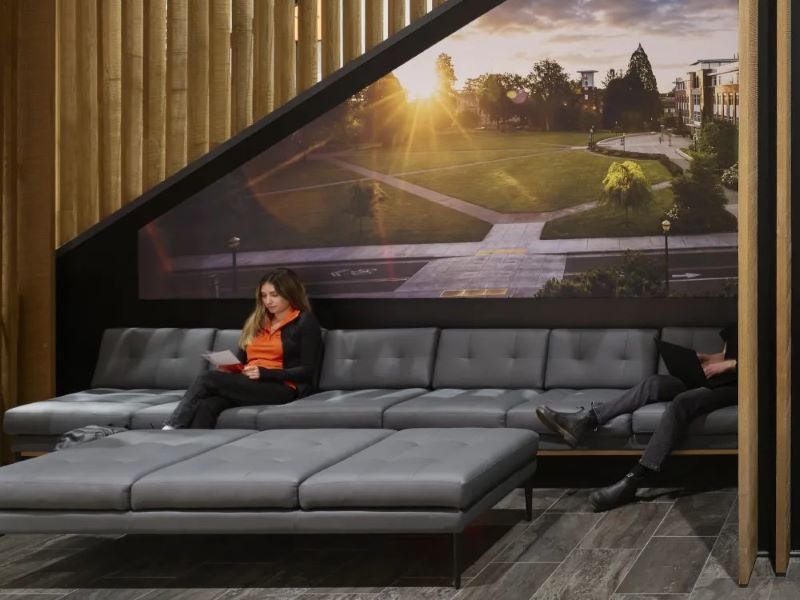
Reser Stadium features year-round university facilities such as a new interactive welcome centre for prospective students interested in joining OSU, new health centre facilities for students of the university’s Corvallis campus, healthcare facilities for OSU’s faculty members and staff, and a new meeting area for university staff, students and faculty.
A new 35,000ft² four-storey Wellness Clinic was built on the south-east corner of the stadium to provide student care services including counselling, primary care, X-ray, laboratory services, and a wellness clinic to offer primary and urgent care services.
The west side of the stadium is equipped with a 417ft wide × 3ft high light-emitting diode (LED) fascia videoboard, with 10mm pixel spacing.
Fast-casual dining and self-service grab-and-go stores were incorporated to replace traditional walk-up stands. Food and beverage offerings have also been reimagined to reflect the OSU fanbase through popular local restaurants.
Design details
The 360-degree concourse allows spectators to traverse and experience new spaces and amenities on the west side. It provides a connection in the bowl and on the concourse, enabling an open-air direct view and a unified fan experience.
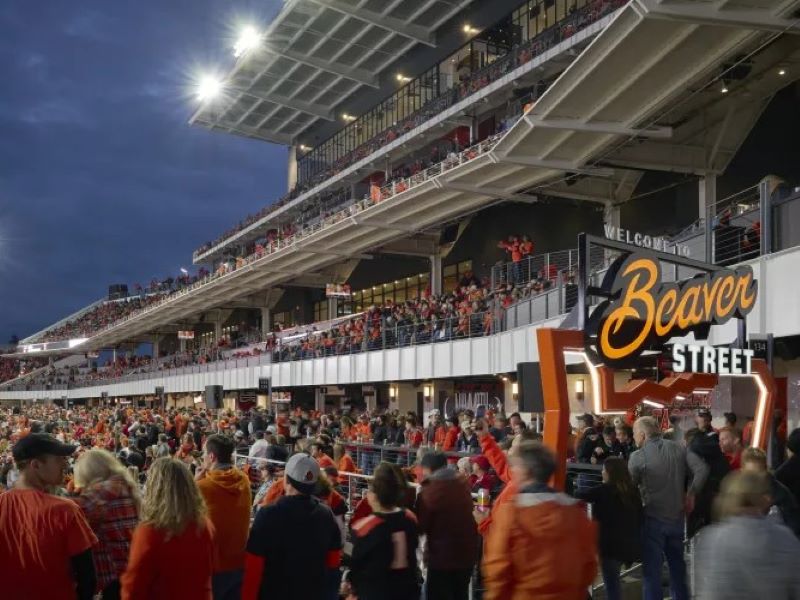
Urban streetscape elements are incorporated in the expanded concourse, known as ‘Beaver Street’, which acts as a crossroads between the south concourse and the existing open-air north terrace.
Soft seating areas, drink rails, high-top tables and several other non-ticketed seating options have been created along Beaver Street. The design offers protection from rain, although the concourse has an open-air environment. Concession areas have more of a storefront appearance, reflecting the urban streetscape and the Pacific Northwest’s food hall culture.
The choice of external finishes, including brickwork, white-painted steel, charcoal-grey metal cladding and Beaver Orange highlights, helps the new build tie in with the existing stadium and the wider campus context.
Seating options
Premium seating options are made available for fans in Beaver Street, allowing them to get as close to the field as possible. The redesigned area has 1,600 chair-back seats for season ticket holders. The seats are arranged less than 80ft from the field, the closest seating for any collegiate stadium.
The premium seating deck, which is located 100ft away from the sideline, features multiple covered options such as loge boxes, club seats, living room boxes and founders’ suite seats. The two distinct club spaces and central Founders Suite provide open views to the interior seating bowl.
Financing
The renovation project financing was arranged from multiple sources including philanthropy, revenues from space lease within the stadium complex, premium seating, and other revenues from the stadium and new facilities.
The project received $85m in funds, netting an additional $6.4m, of which $1m was donated for the Student Health Centre (SHC) and $5.4m for the stadium. The additional $1.1m necessary for the SHC is planned to be covered through revenues from the health centre, additional fundraising and/or the existing balance of Student Building Fee reserves.
OSU also received two separate donations of $50m and $10.5m from anonymous donors for the project.
In addition, several funded scope enhancements totalling $348,000 were added to the project for adjacent improvements completed as part of the project.
Contractors involved
Architecture design and planning companies Populous and SRG Partnership, and construction contractor Hoffman Construction designed the new Reser Stadium project. Hoffman served as the design-build partner of Populous. CannonDesign served as a key architectural partner.
J&S Masonry was tasked with the extensive brick and masonry work including the installation of more than 43,000 bricks on the new stadium.
Magnusson Klemencic Associates provided structural engineering services, while PAE Engineers served as the mechanical, electrical and plumbing engineer, and KPFF Consulting Engineers provided civil engineering services for the project.
Sports entertainment agency ANC delivered new LED video displays that were manufactured by Lighthouse Technologies for the Reser Stadium renovation project.
Ricca Design Studios and Western Partitions were also involved in the project.
