


For two decades, construction has been on a journey of digital transformation. We moved from paper to PDFs, from standalone CAD to specialist tools for estimating, coordination, field management, and handover. And yet, if you look under the surface of most major organisations, the uncomfortable truth is this: we’re still operating like a document industry – and the data gap that is emerging is getting harder to ignore.
Even as AECO firms adopt AI-powered tools and AI agents and experiment with digital twins, they’re trying to do it on top of fragmented systems, inconsistent standards, and project data trapped in files and disconnected platforms.
How to fix data governance in a uniquely complex; uniquely fragmented industry
Findings from our latest State of Design & Make: Spotlight on Construction report[i] show just 38% construction leaders rate their company’s ability to share data as strong, with the majority saying their data-sharing abilities are just acceptable. Now, we know that in our uniquely complex; uniquely fragmented industry, this is understandable.
Owners, designers, contractors, suppliers, and facility managers all contribute to the outcome – but they do it through contractual boundaries that often encourage risk to be pushed around rather than shared.
Compare that to manufacturing, where a vertically integrated company can standardise processes, systems, and data end-to-end. In construction, the value chain spans the entire asset lifecycle with very little vertical integration. Every project becomes a new coalition of organisations, each with their own stack of tools and their own way of structuring information.
The problem isn’t “too many tools”, or even interoperability of formats. The problem is that the data between them doesn’t align at a granular level. If the Owner needs to know the operational flow rate of a pump to operate it effectively, but the engineer can give that piece of information any name they like, how do they reconcile the data? It’s like trying to merge 100s of spreadsheets each with different column titles.
And the hidden cost of that disconnection is enormous: people reconciling information from multiple systems, rebuilding models from 2D drawings, workarounds using spreadsheets, re-entering the same information, for handover because no one agreed the data requirements up front, and making high-stakes decisions without confidence in what’s current, complete, or correct.
Why AI is forcing the issue now
AI is acting like an accelerant. It’s making the industry’s data maturity, or lack of it, impossible to ignore.
Yes, large language models can be impressive. But we’ve also all seen the failure modes: hallucinations, missing context, confident wrong answers. In construction, “confident wrong” isn’t just inconvenient—it can be catastrophic. Bridges don’t just “iterate.” Buildings don’t get a software patch when thermal comfort fails. The built environment has consequences.
That’s why scaling AI in construction depends less on clever prompts and more on solid foundations: structured, validated, and governed data that can be easily shared.
When I speak with CTOs and digital leaders across major owners, contractors, and design firms, many are already running pilots with AI agents. But nearly all hit the same reality when they try to scale: before you can automate decisions, you need consistent data. Before you can build copilots, you need trusted context. Before you can mine portfolio insights, you need information that’s accessible beyond a small group of experts working across increasingly complex software environments.
Sustainability requirements and ESG reporting are another force pushing the industry toward data maturity. Whether it’s embodied carbon, supply chain transparency, safety metrics, or audit trails, organisations are being asked to prove, not just claim, performance.
That requires structured, traceable data. Not last-minute reporting exercises stitched together from disconnected sources. And as regulations tighten, the organisations with governed, connected data will respond faster, at lower cost, with less risk.
But across the industry, three issues emerge repeatedly as blockers to achieving consistent, structured data capture and sharing practices fit for our times. These are:
1) Accessibility: critical information is locked inside complex files
The data that matters most is typically wrapped up in monolithic files: models, PDFs, schedules – and accessible primarily only by specialists. If you’re not a power user in the authoring tool, extracting answers can be slow, manual, and brittle.
The industry can’t build a broad culture of data-driven decision-making if access to the data requires expert mediation.
2) Fragmentation: the “door problem”
Take something as simple as a door. You might have a door schedule, a specification, a drawing callout, a procurement submittal, an installation record, and a maintenance requirement. Each representation of that door might be created by a different party, at a different time, under a different contractual responsibility—often in different systems.
The data exists, but it’s not stitched together. That fragmentation makes lifecycle continuity – design to build to operate – far more difficult than it needs to be.
3) Trust: inconsistent structures and no validation
Even when data is available, teams often don’t trust it. Is it complete? Is it current? Is it in the right format? Does “flow_rate_op” mean the same thing as “operational_flowrate”? Are units consistent? Are values within acceptable ranges?
Without consistent schemas and validation, organisations end up doing expensive “data massage” work, typically in Excel, to normalise information after the fact. That’s margin leakage hiding in plain sight.
When data is treated as infrastructure, it stops being a by-product of projects and becomes an enterprise capability, showing up directly in profitability, risk, and the ability to scale best practices.
From files to data: what the next CDE needs to become – and how to get there
The common data environment (CDE) has been the industry’s answer to the information explosion for a while. ISO 19650 is the international standard for managing information across the lifecycle of built assets.
But the next step is to evolve from a CDE that manages files to a CDE that can also manage granular, structured data – the kind AI and automation can reliably maximize.
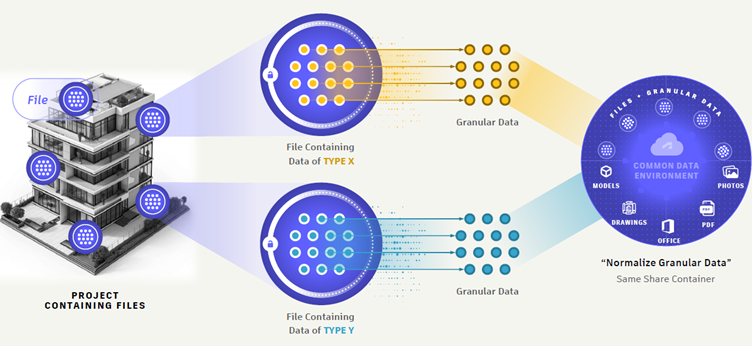
Source: Autodesk
ISO 19650 gives a strong process backbone, but industry-wide data specifications are still emerging.
One of the most preventable causes of rework is ambiguity at handover: “We delivered the BIM model.” “That’s not the data we needed.”
The fix is straightforward, if not always easy: owners be specific about the information requirements up front. Define the properties, formats, validation rules, and intended uses. Procure based on that. Deliver against that. Validate it consistently.
In some sectors, like oil and gas, shared specifications have reduced friction in the supply chain. In the built environment, the fragmentation is greater, but aligning on common schemas in non-competitive areas (like sustainability data) could accelerate the entire market. We’re also seeing emerging standards like CorenetX in Singapore which define the data specification for all public projects, and could provide a blueprint for other regions to adopt either the same standard or a similar approach that the supply chain could rally around.
Leveraging Autodesk solutions to move into the data era
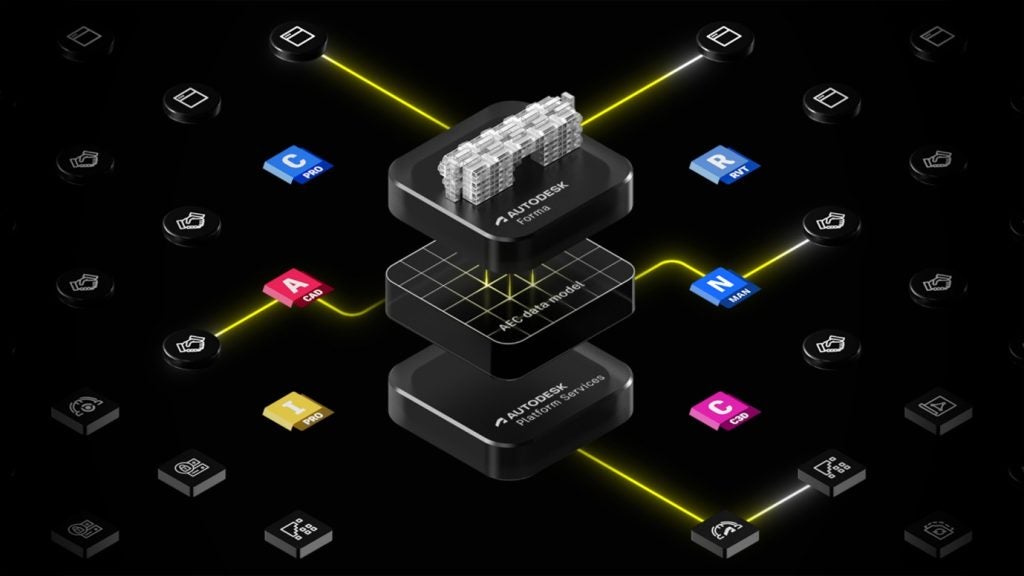
There is no question that the future is a connected information model where components, properties, relationships, and validation rules can be readily accessed and understood across tools and teams – and Autodesk’s goal is to enable that through the Forma Industry Cloud.
Autodesk Forma is a cloud-based construction management platform that connects teams, data, and workflows across all lifecycle phases—from design and preconstruction to construction and operations. It serves as a central source of truth for project documents, reducing rework, mitigating risk, and improving project delivery.
Source: Autodesk
Forma Data Management underpins this environment with robust information management and permissions, and it’s certified to support ISO 19650-aligned processes—helping teams manage naming conventions, status workflows, and controlled publishing.
The Data Service within the AEC Data Model help shift from file-based workflows to structured, interoperable data—exposing information uploaded into Forma Data Management at a granular level so it can be queried, connected, and used by non-experts and downstream systems. And Datum supports the move toward validated, governed data environments—so organisations can specify what “good data” looks like up front and check it consistently, rather than relying on manual cleanup late in the project.
Together, these capabilities support three essential outcomes:
- Make data accessible beyond specialist tools and monolithic files.
- Make data trustworthy through clearer definitions and validation.
- Make data connected across representations—models, specs, schedules, commissioning, and operations.
When data is infrastructure, then firms can move beyond project-level reporting to portfolio intelligence and AI can unlock genuinely valuable insights & workflows.

Paul Markovits
Paul leads Autodesk’s Product Management group building information lifecycle management capabilities to the firm’s AEC Data Platform; tasked with helping our customers specify information requirements, then aggregate and validate asset information against those requirements. Having started as a civil structures engineer, Paul spent more than eight years at a startup implementing early CDEs on the UK market and defining product strategy to align with BS1192. At Autodesk he has supported customers with early BIM to FM integrations and so understands the importance of information requirements being defined early in the lifecycle. He has helped customers understand and implement ISO 19650 standards to support this. After almost 25 years working with CDEs, Paul is excited about the opportunity granular data is going to bring the industry and the new ways of working needed to support Stage 3 Information Management.
[i] https://construction.autodesk.com/go/design-and-make-construction-spotlight-report/
