

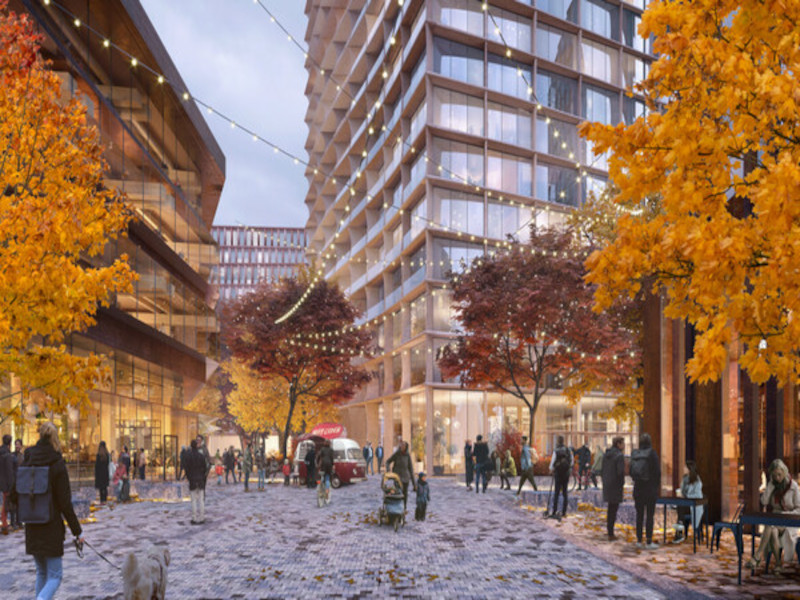
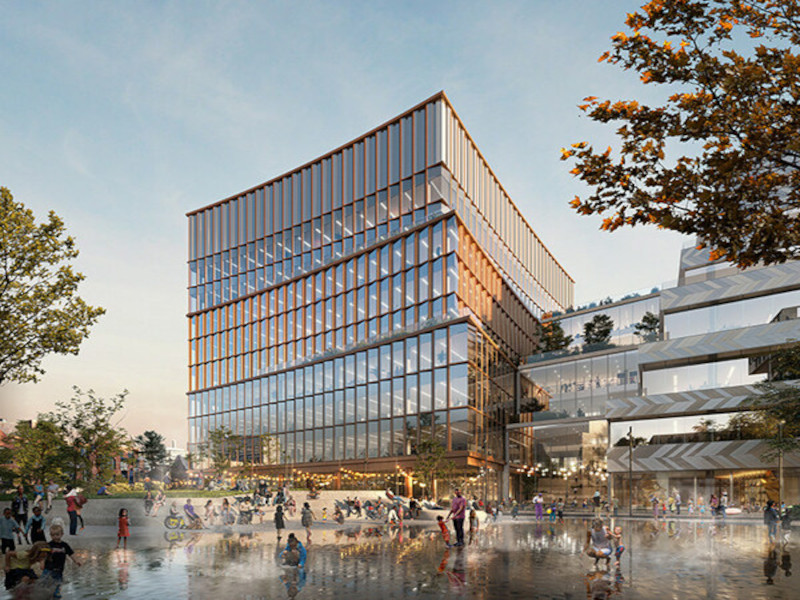
Harvard University’s Enterprise Research Campus (ERC) in Boston in the US state of Massachusetts is a mixed-use urban district that will include office, laboratory, residential and public spaces to support interaction between industry and research activities.
The Harvard Allston Land Company (HALC), a subsidiary of Harvard University, is responsible for its planning and development.
Recommended Buyers Guides

The Enterprise Research Campus is being developed in two phases, A and B.
The plan to develop ERC is based on a 2018 Harvard-led visioning and community engagement process. The Boston Planning and Development Agency (BPDA) board approved the initial regulatory document for the development in March 2018 and green-lighted the first phase of the project in July 2022.
A groundbreaking ceremony to officially mark the start of construction for the first phase was held in November 2023.
The process to secure approval for Phase B of ERC began in April 2024 with the submission of a letter of intent (LoI) to BPDA.
The David Rubenstein Treehouse, Harvard’s first university-wide conference centre and one of the components of the first phase, opened in November 2025. Other components of the ERC are planned to open in early 2026.
The project is anticipated to generate 4,300 jobs, comprising 2,000 union construction roles across various trades, and 2,300 permanent on-site positions in sectors such as life sciences, building operations, retail and hospitality.
Enterprise Research Campus location
The ERC is situated in the Boston neighbourhood of Allston at 100 to 112 Western Avenue, Massachusetts (MA) 02134.
The campus is positioned next to Harvard’s new Science and Engineering Complex (SEC), across the street from Harvard Business School (HBS), near i-lab, Life Lab and Launch Lab initiatives.
The ERC will occupy 36 acres (14.57ha) of land previously managed by CSX Transportation (CSXT) for rail operations. Under an agreement between CSXT and Harvard, rail services on the property were discontinued, existing structures were removed, and environmental testing and remediation were carried out.
Enterprise Research Campus development details
Phase A of the Enterprise Research Campus will cover 14 acres and includes a gross floor area of 900,000ft² (83,612m²). It will include the operational David Rubenstein Treehouse, two laboratory buildings known as One Milestone East and One Milestone West with a combined space of 440,000ft², and the Atlas Hotel, a 16-storey building with 246 rooms.
The first phase will also include 343 residential units distributed across two buildings, consisting of an eight-storey mid-rise tower and a 17-storey high-rise that incorporates a green rooftop terrace, ground-floor retail and resident amenities.
Around 25% of these units will be designated for households with incomes between 30% and 100% of the area median income (AMI).
In addition, Phase A will provide a greenway and flexible outdoor space totalling more than two acres of publicly accessible green space intended for activities such as farmers’ markets, musical performances and fitness classes.
The open space will be centred around a Greenway connecting historic Allston towards the Charles River.
Post approval, ERC’s Phase B will be developed on a 4.8-acre parcel located to the west and south of Phase A.
It is planned to have a total gross floor area of 1.04 million ft², including 720,000ft² of additional laboratory and office space, 320,000ft² of residential housing that incorporates ground-floor retail and community spaces, and areas of public landscaping.
Transport infrastructure and improvements
The ERC is served by bus routes 64, 66, 70 and 86, with ongoing collaborations to improve transit along Western Avenue. Upgrades will include enhanced bike facilities, sidewalks, a 15m (50ft)-wide pedestrian promenade and low parking ratios.
Plans also include the construction of three new multimodal streets and the creation of a permanent transit hub at West Station.
Sustainability features
The ERC’s office and lab buildings are targeting Fitwel certification for a healthy, sustainable and equitable work environment. The project is focused on sustainability, aiming for 100% electric residential buildings, 38% energy reduction and 60% carbon reduction.
Site-wide green roofs and permeable paving, along with an advanced stormwater management system, are planned to be implemented. The buildings are designed to meet the USGBC LEED Gold standard and incorporate energy-efficient heating, ventilation and air conditioning, and lighting.
The campus also aims to receive Platinum-level Envision certification, a sustainability rating system designed for infrastructure projects.
The ERC has set goals to become fossil-fuel-neutral by 2026 and fossil-fuel-free by 2050, aiming for substantial cuts in energy consumption and emissions.
The project will introduce more than 800 new trees, resulting in almost one-third of the area being shaded by tree canopy to reduce peak summer temperatures and lower air pollution.
Financing
In June 2023, JLL’s Capital Markets group arranged a $750m construction loan for the ERC’s first phase. The financing was led by Otera Capital.
The ERC development is planned as a significant inclusionary investment initiative in Boston, having engaged more than 150 Black and Hispanic individuals and households as owners. As a group, they contributed more than $30m in equity investment.
As part of the planning process, Harvard pledged to invest up to $1m and engage in a city-led planning and re-zoning process for the remaining ERC land outside the 14-acre PDA Master Plan area.
Contractors involved
Real estate company Tishman Speyer was contracted to develop Harvard University’s Enterprise Research Campus in Allston.
Tishman Speyer, in partnership with Breakthrough Properties and LabCentral, will manage lab spaces for the ERC. Breakthrough Properties, a joint venture between Tishman Speyer and Bellco Capital, specialises in life science properties, while LabCentral offers shared lab space to life sciences and biotech startups in Boston.
Jeanne Gang, an alumna of the Harvard Graduate School of Design and founding principal of Studio Gang, will co-lead the project’s architecture alongside Henning Larsen from Copenhagen.
The project will also involve the landscape architecture firm Scape, the Arup Group for integrated planning, and the Boston-based urban design firm Utile.
The residential building is designed by MVRDV with co-architect, Moody Nolan while Marlon Blackwell Architects is responsible for the hotel design.
Consigli Construction and Smoot Construction are handling the construction of these components, with Odeh Engineers and Cosentini.
Turner Construction Company, alongside joint venture partners Janey Construction Management and J&J Contractors, is responsible for building the Enterprise Research Campus East and West Lab buildings.
Nitsch Engineering is associated with the project as the civil engineer, while Haley & Aldrich is providing geotechnical engineering services.
NelsonNygaard, Level Infrastructure and Wordsearch are providing consulting services, and DLA Piper is responsible for zoning matters.
Tillotson Design Associates and George Sexton Associates were in charge of lighting services for David Rubenstein Treehouse. Code Red Consultants was responsible for accessibility and code compliance, while Simpson Gumpertz & Heger handled waterproofing consulting services.
